Group Lessons Versus Home Tuition: Which Works?
A child who understands fractions at home may still freeze when a school test presents the same idea in a multi-step word problem. A student who writes well may still lose marks because their composition lacks clear planning, precise vocabulary, or the format expected in exams. That is why the decision between group lessons versus home tuition is not simply about where your child studies. It is about the kind of teaching, practice, feedback, and motivation that will help them improve.
For Singapore parents, the choice often becomes urgent when grades slip, the PSLE approaches, or homework turns into a daily struggle. Both options can help. The better fit depends on your child’s learning gaps, personality, subject needs, and the quality of the teacher.
Group Lessons Versus Home Tuition: The Real Difference
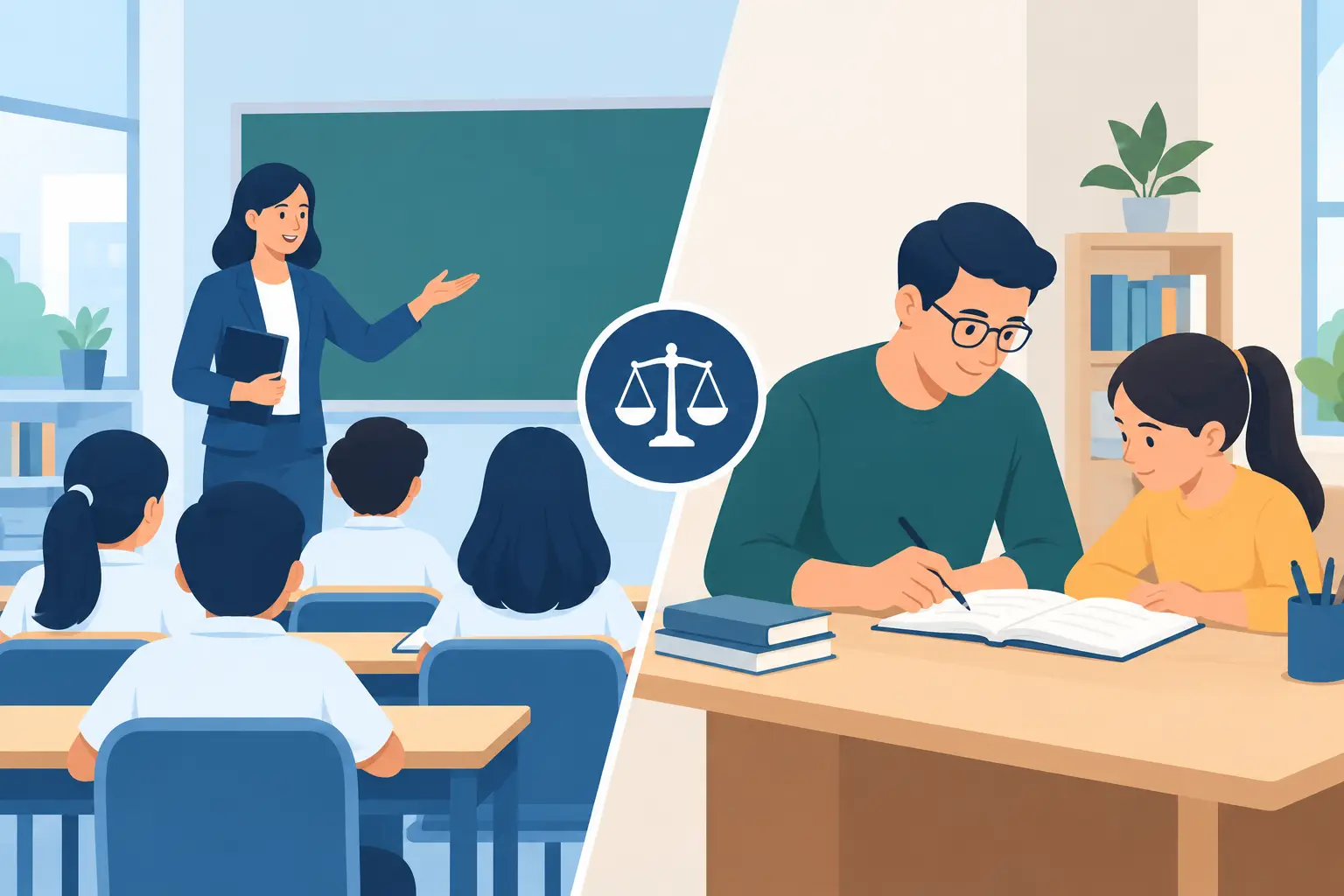
Home tuition gives one student the teacher’s full attention. Lessons can move at the child’s pace, whether that means revisiting Primary Math fractions, working through Secondary Math algebra, or correcting weak English grammar sentence by sentence. This can be valuable for a student with significant foundational gaps, anxiety in a classroom setting, or a very specific academic target.
Group lessons, particularly in a small class, create a different kind of advantage. Students learn alongside peers who are tackling similar school topics and exam questions. A strong teacher can explain a concept, model the method, check understanding, and guide students through practice before misconceptions become habits. The class setting also helps children see that others make mistakes, ask questions, and improve through effort.
The key distinction is not simply individual teaching versus shared teaching. It is whether the lesson has enough structure and personal attention to turn weak concepts into reliable exam performance.
When Home Tuition May Be the Better Choice
One-to-one home tuition can be highly effective when a child needs a customized recovery plan. A student who has missed major topics due to illness, has fallen far behind in class, or cannot yet manage basic skills may benefit from concentrated individual support.
It can also suit children who are easily distracted in a group or reluctant to speak up around classmates. A capable tutor can adjust the pace immediately, spend longer on difficult questions, and choose materials that target one child’s errors. For example, a Secondary Science student struggling with open-ended questions may need repeated coaching on how to identify keywords, apply concepts, and write complete explanations for Biology, Chemistry, or Physics.
However, home tuition is only as effective as the tutor’s expertise and lesson plan. A weekly session that mainly helps a student finish homework may bring temporary relief without fixing the underlying issue. Parents should look beyond convenience and ask whether the tutor is teaching clear methods, setting purposeful practice, marking work carefully, and tracking progress over time.
Home tuition can also become expensive, especially when families need support across English, Math, Science, and Chinese. A higher price does not automatically mean stronger teaching or better results.
Why Small-Group Lessons Build Stronger Habits
A well-run small group gives students something that individual tuition cannot always replicate: productive academic pressure. When classmates are attempting the same challenging problem, students are more likely to stay focused, compare methods, and take responsibility for their own answers.
This matters in school examinations. Your child will ultimately sit for papers independently, manage time, interpret unfamiliar questions, and choose the right method without a tutor beside them. Group lessons can build that independence through guided practice, timed questions, discussion, and regular feedback.
Small classes also make it possible for teachers to spot common weaknesses. If several students confuse ratio with fraction, the teacher can address the misconception directly before moving to harder applications. If a class is losing marks in English comprehension because answers are too vague, the teacher can demonstrate how to lift evidence from the passage and explain it clearly.
The best group programs do not treat every student identically. They use a structured curriculum while giving targeted guidance during practice. A child may be working on the same topic as the class but receive extra correction on careless calculation, weak inference, poor editing, or incomplete Science explanations.
The Quality of Teaching Matters More Than the Format
Parents sometimes assume home tuition is automatically more personalized and group lessons are automatically generic. That is not always true. A large class with limited feedback may not meet a child’s needs, but neither will a one-to-one tutor who lacks subject expertise or follows no clear plan.
Look for teachers who understand the local syllabus, common exam traps, and the skills behind marks. Strong English teaching should go beyond vocabulary lists. Students need to learn comprehension techniques, grammar and editing rules, writing structures, and how to develop ideas for creative and argumentative writing.
Strong Math teaching should not stop at getting an answer. Students need to understand why a method works, how to choose it under exam pressure, and how to avoid common errors in ratios, fractions, algebra, and trigonometry. In Science, they need more than memorized facts. They need to apply concepts accurately and communicate answers in the language expected by the question.
Experienced educators, including former MOE teachers and subject specialists, can make a meaningful difference because they know where students commonly struggle and how to correct those gaps efficiently.
Consider Your Child’s Current Learning Stage
The right option can change as your child progresses. A Primary 3 student building basic number sense may thrive in a supportive small group that makes learning feel normal and achievable. A Primary 6 student preparing for the PSLE may need structured, exam-focused practice with close feedback on weak areas.
For secondary students, the demands often become more complex. Math questions require longer chains of reasoning. English writing calls for stronger organization and maturity of ideas. Science answers must be precise enough to earn marks in open-ended sections. At this stage, students usually benefit from a program that combines concept teaching, application practice, paper review, and exam technique.
Ask yourself a practical question: does your child need exclusive attention for a short-term gap, or do they need consistent structure and disciplined practice over months? The answer often points to the better format.
Questions to Ask Before You Enroll
Before choosing group lessons or home tuition, assess what is actually happening in school. Review recent tests and worksheets instead of relying only on overall grades. A B may hide weak foundations, while a lower score may come from poor time management rather than a lack of understanding.
Ask whether your child can explain the topic in their own words, complete similar questions independently, and learn from corrections. Notice whether they avoid work because it feels difficult, or because they have not developed a steady routine. These details matter more than whether a friend recommends a particular tutor.
It is also worth asking how progress will be measured. Will work be marked? Will the teacher identify recurring mistakes? Will your child receive help between lessons when they are stuck on homework? Families should expect clear academic support, not vague promises.
At Everyday Tuition, small-group instruction is designed to give students structured teaching, personal guidance, and practical exam support without making quality tuition feel out of reach for everyday families.
Choose the Setting That Helps Your Child Practice Independently
The best tuition arrangement should make your child less dependent on tuition over time. They should become more willing to attempt difficult questions, better able to explain their thinking, and more confident when a test presents an unfamiliar problem.
Choose home tuition when your child genuinely needs intensive one-to-one intervention and the tutor can provide a focused plan. Choose a small group when your child needs expert instruction, consistent practice, peer motivation, and individual feedback within a structured program. A child does not need the most expensive option. They need the right teaching, repeated practice, and enough support to turn effort into better grades.